

Share this
by Digital Euro Association on Jul 21, 2026, 7:44:59 AM
Welcome to the latest edition of the Digital Euro Association's Quarterly Insights!
This comprehensive blog post presents a concise overview of our association's activities and achievements over the past three months. As we continue to navigate the ever-changing landscape of digital money, this summary highlights our strides in promoting financial innovation, fostering education, and exploring groundbreaking initiatives.
Join us on this exciting journey as we delve into the key milestones and accomplishments that shape the future of digital money!
New Members

In Q2 2026, the DEA welcomed Crunchfish as its newest lite member.
Crunchfish provides foundational offline payment technology designed to be governed by providers of payment systems, integrated by providers of payment applications, and deployed across payment ecosystems, without changing settlement discipline, authority, or roles. This includes SDKs for offline wallets and offline terminals, offline protocols and APIs, and offline backend components for verification, synchronisation, and settlement conversion. Offline capability is delivered as Layer-2 infrastructure that can be governed centrally and applied consistently across payment systems.
Distinguished People and Public Affairs
AI & Blockchain: Building Blocks of Digital Sovereignty
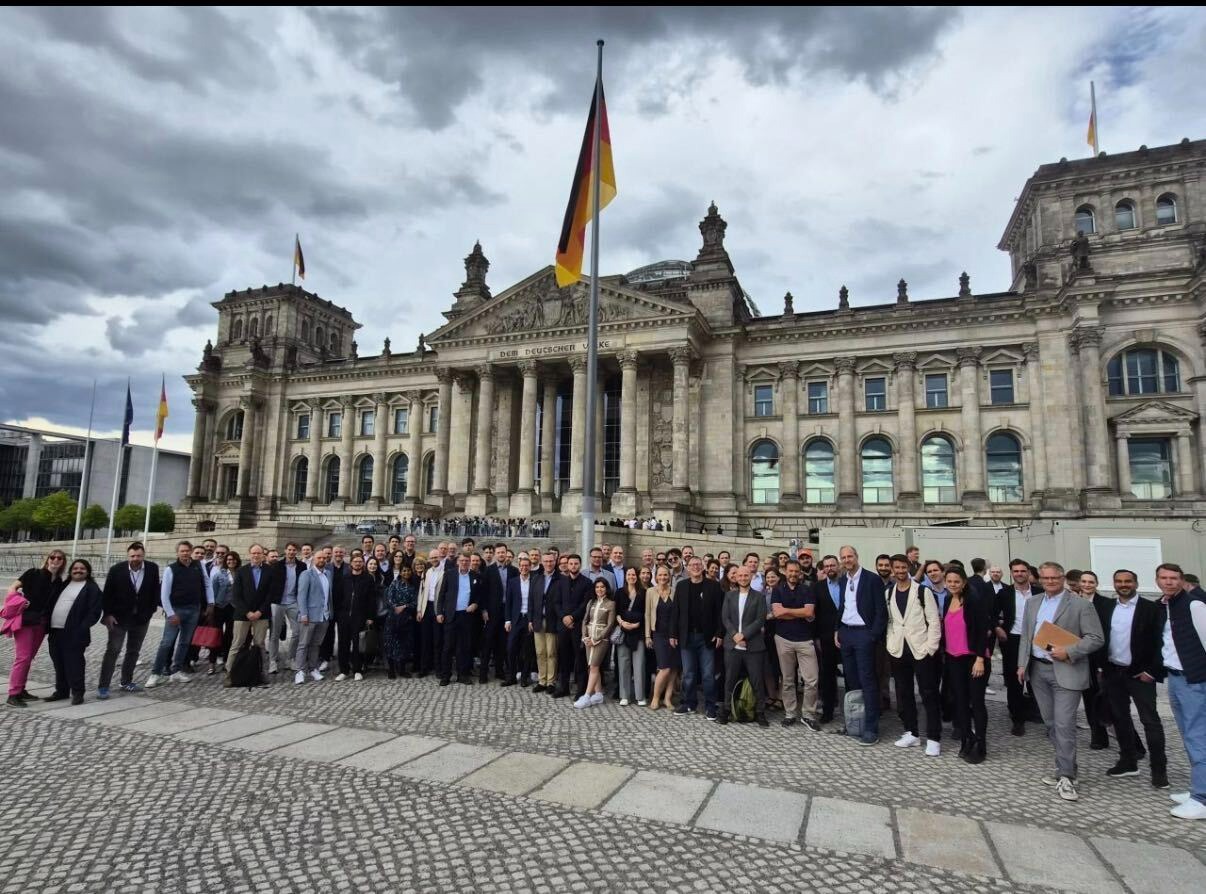
The DEA participated in the event AI & Blockchain: Building Blocks of Digital Sovereignty at the German Bundestag, contributing to a panel discussion on Payment Solutions for the Age of Agentic AI.
Representing the DEA, Chairwoman Anne-Sophie Gógl shared perspectives on the role of digital money and payment infrastructure in strengthening Europe's digital sovereignty. The discussion emphasized that achieving strategic autonomy requires more than advancing individual technologies—it depends on building trusted, interoperable digital infrastructures that support innovation, resilience, and competitiveness.
Bringing together policymakers and industry experts, the event highlighted the growing importance of payments, AI, and blockchain as interconnected building blocks of Europe's digital future and underscored the value of fostering these conversations within the political arena.
Read more 👇
https://digital-euro-association.de/blog/payments-agentic-ai-digital-sovereignty-bundestag
DEA Key Priorities Ahead of the ECON Vote
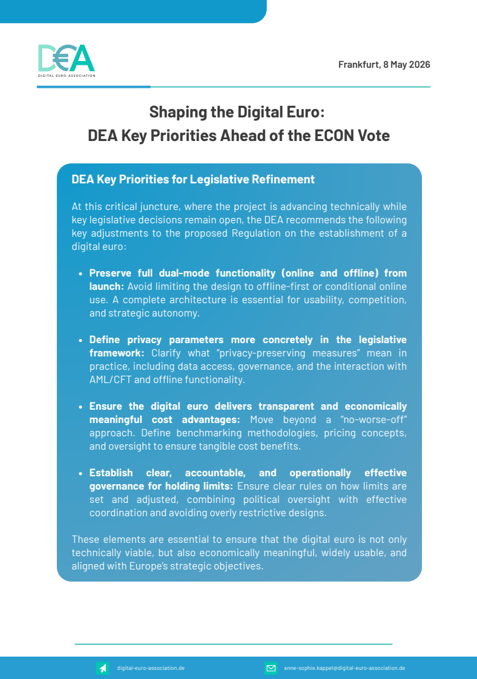
As negotiations on the Digital Euro Regulation entered a decisive phase, the DEA submitted a position statement to Members of the European Parliament outlining its recommendations for legislative refinement. Combining the DEA’s own policy positions with practical insights from across the digital money ecosystem, we provided targeted recommendations on key design choices that will shape the future of the digital euro. Through initiatives such as these, the DEA continues to ensure that industry expertise has a direct voice in European policymaking – translating cross-sector expertise into actionable input to ensure that practical experience informs Europe's digital money agenda.
💎 Access is exclusive to DEA members. Know more about the DEA memberships here.
DEA Welcomes ECON Committee Vote as Important Step in Digital Euro Legislation
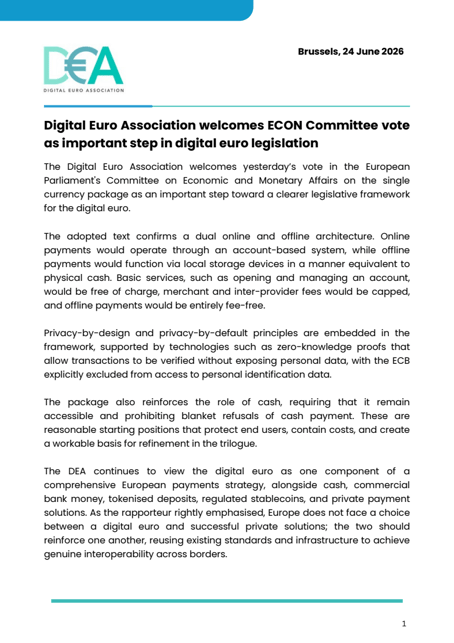
The DEA welcomed the European Parliament's ECON Committee vote on the Digital Euro Regulation as a significant step towards establishing Europe's future public digital money. In our analysis, we highlighted the legislative progress made while identifying the critical implementation choices that remain, including privacy, offline functionality, holding limits, interoperability, and incentives across the payments ecosystem. As the files move into trilogue negotiations, the DEA continues to contribute independent expertise and foster dialogue between policymakers and stakeholders to help shape a practical, future-proof digital euro.
DEA Publications
The Eurosystem’s comprehensive payments strategy
Our April member briefing analysed the ECB's new payments strategy and what it signals for the future of Europe's payments ecosystem. Going beyond the official publication, the DEA explored how the strategy integrates the digital euro, tokenisation, wholesale settlement, instant payments and regulated private digital money into a coherent policy framework, while assessing the implementation challenges, interoperability questions and strategic choices that will shape the next phase of Europe's payments landscape.
💎 Access is exclusive to DEA members. Know more about the DEA memberships here.
ECB digital euro pilot focus session
Ahead of the ECB's deadline for payment service providers to apply for the digital euro pilot, the DEA published an exclusive member briefing analysing the legal, technical and operational framework underpinning participation. The briefing examined the PSP Participation Agreement, front-end and back-end specifications, API architecture, governance arrangements and the strategic implications of the pilot for payment service providers. It also assessed how the pilot marks the transition from policy development to operational implementation, highlighting the opportunities, challenges and key considerations for market participants as the project moves closer to real-world deployment.
💎 Access is exclusive to DEA members. Know more about the DEA memberships here.
MiCA Consultation
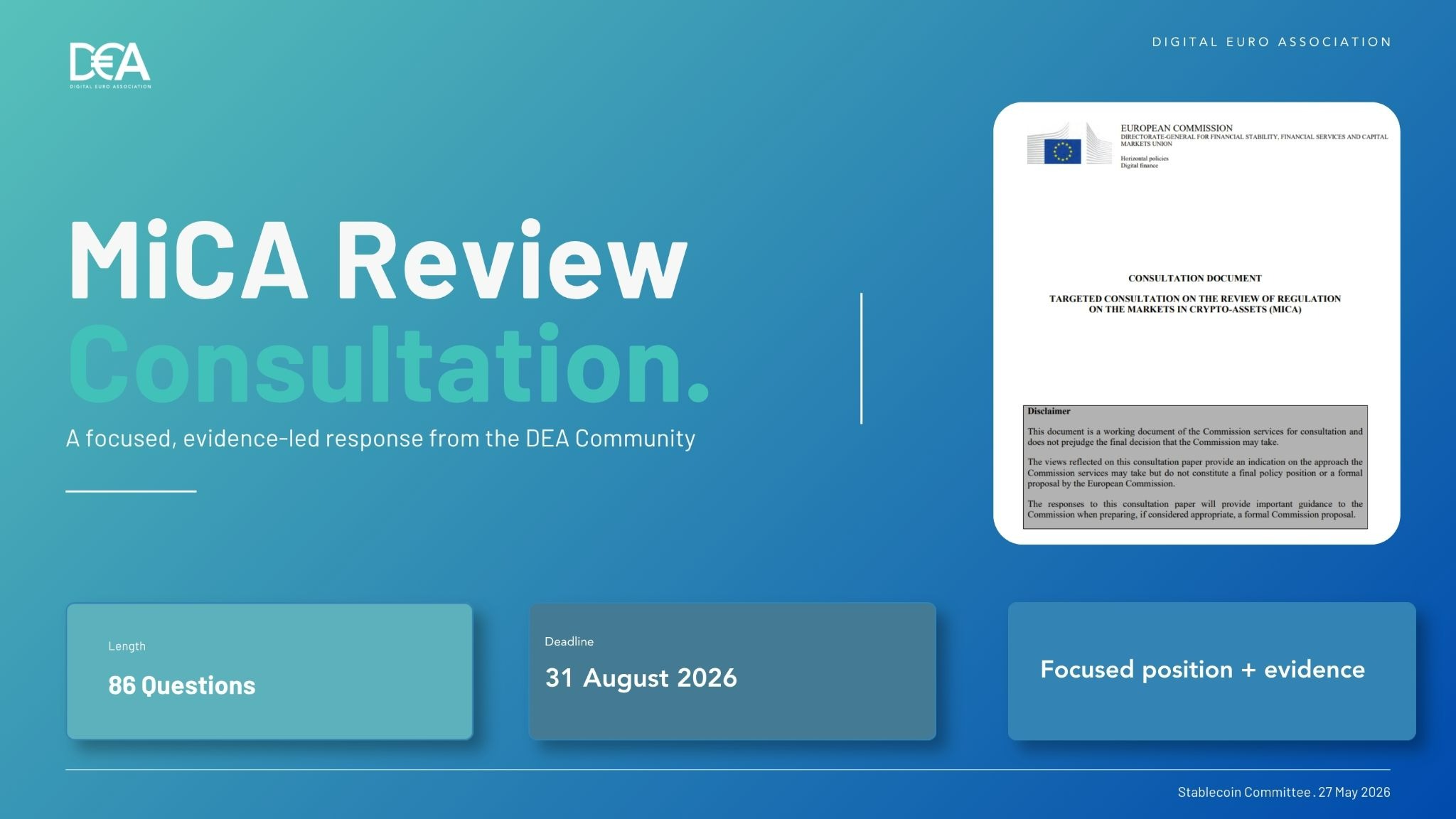
In Q2 2026, the DEA launched a coordinated response process for the European Commission’s targeted consultation on the MiCA Review. The DEA is focusing on the questions most relevant to ARTs, EMTs and stablecoin issuers, including the future role of stablecoins in Europe, reserve and liquidity requirements, redemption, multi-issuance models, equivalence, proportionality and issuer-CASP reporting.
Through the Stablecoin Committee, members and select expert contributors were invited to provide practical, evidence-led input based on concrete issues, market or operational examples, and workable policy recommendations. The aim is to develop a coherent DEA response that identifies where MiCA is working, where it may be overcorrecting, and where targeted adjustments could support a competitive, well-regulated European stablecoin ecosystem.
DEA Events
CBDC Committee
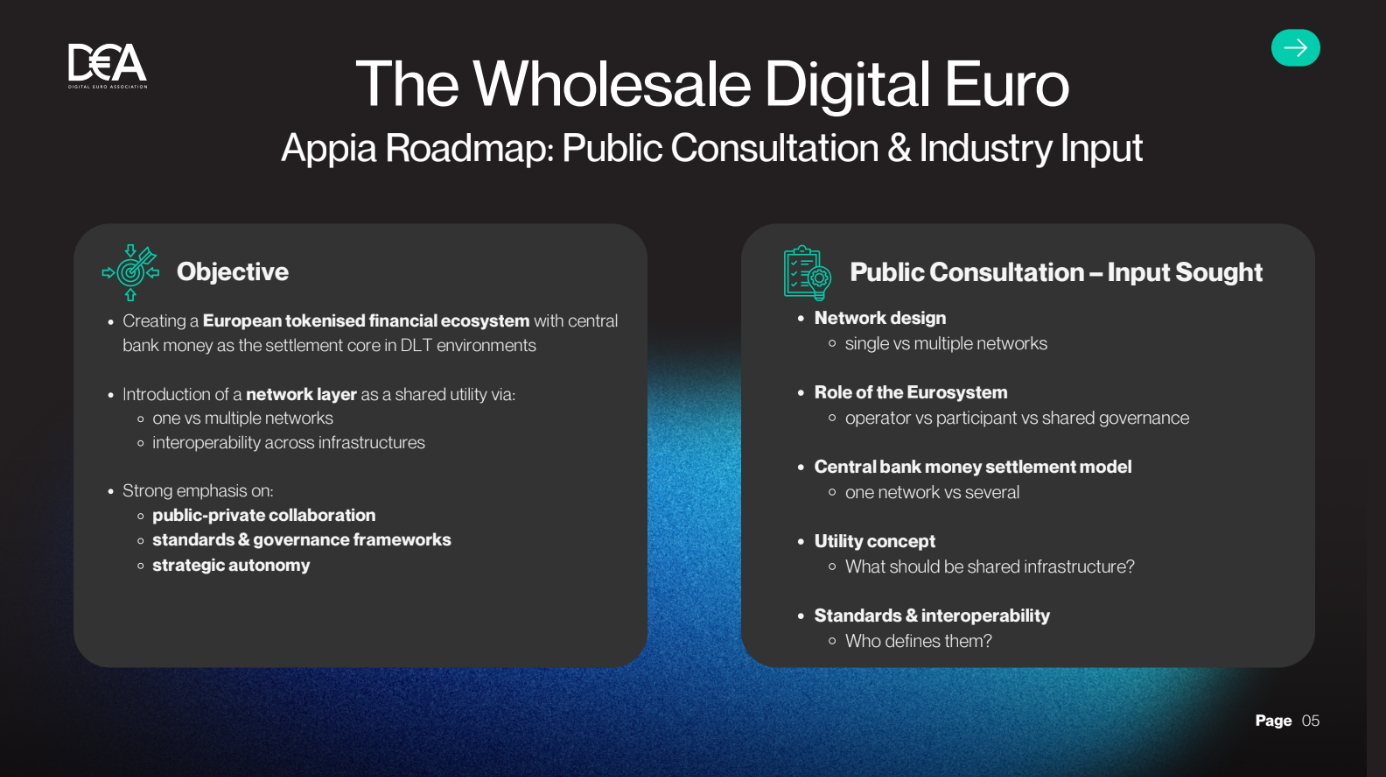
During Q2, the DEA CBDC Committee brought together members from across the digital money ecosystem to discuss the most significant developments in the retail and wholesale digital euro.
The April session focused on the legislative negotiations ahead of the European Parliament's ECON vote. Participants exchanged views on some of the most debated elements of the digital euro framework, including the balance between online and offline functionality, privacy and data minimisation, merchant incentives, holding limits, and governance. The committee also discussed the Eurosystem's Appia roadmap and the future role of wholesale central bank money in Europe's tokenised financial ecosystem.
In May, discussions shifted towards market readiness and implementation. Members reviewed the latest developments in the ECB's digital euro pilot, the Innovation Platform, and international CBDC initiatives, while also assessing the DEA's key policy priorities ahead of the ECON vote. The session concluded with a discussion on how the digital euro should ultimately be positioned—as a payment innovation, a resilience infrastructure, or a sovereignty instrument—and what is needed for successful ecosystem adoption.
As legislative negotiations progress and implementation work accelerates, the CBDC Committee continues to provide a platform for informed discussion, knowledge sharing, and industry engagement on the future of digital money in Europe.
Stablecoin Committee
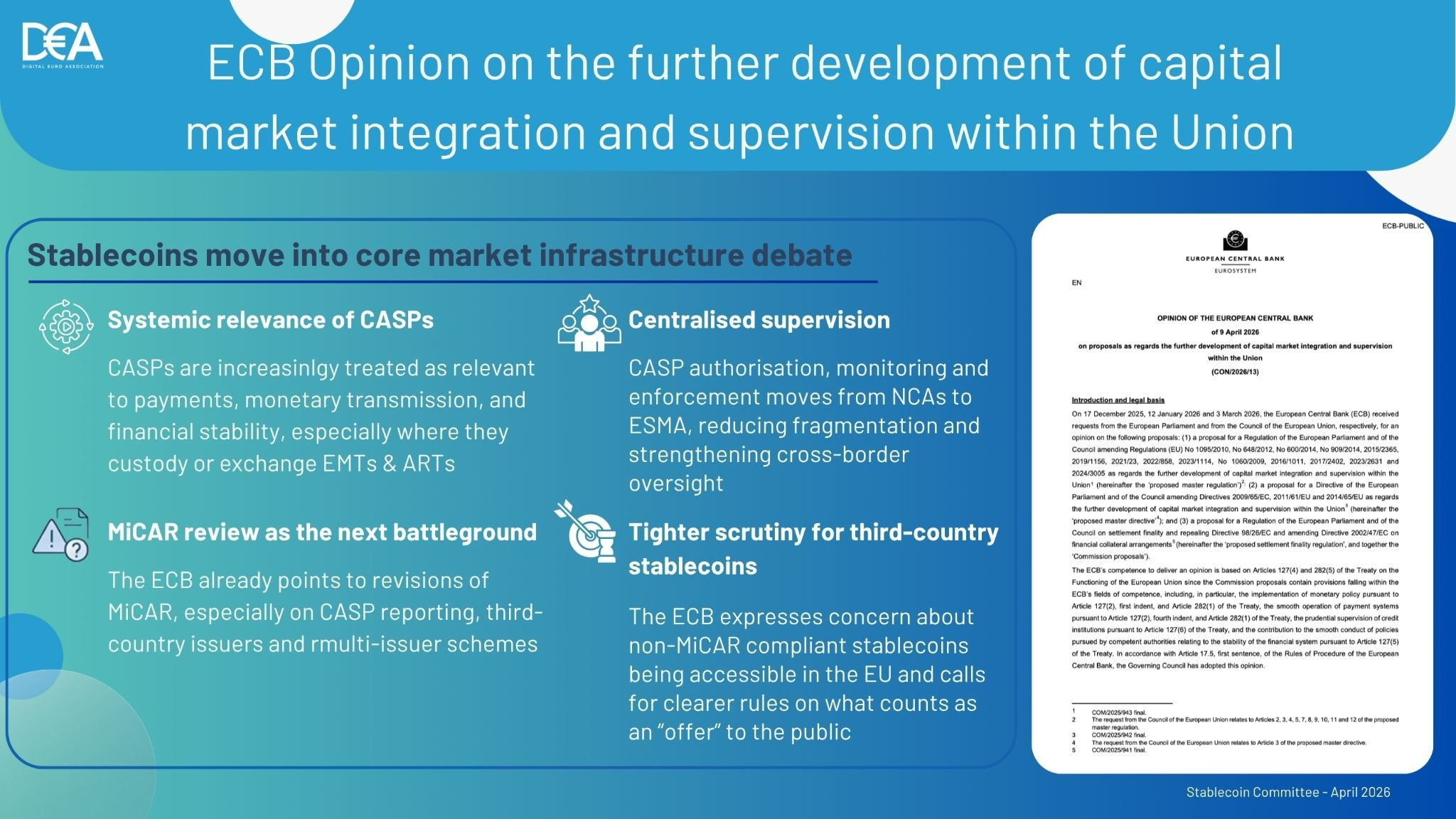
In Q2, the DEA Stablecoin Committee focused on the growing role of stablecoins within Europe’s broader financial market infrastructure debate. The Committee discussed the ECB’s opinion on capital market integration and supervision, with particular attention to the increasing systemic relevance of CASPs, the shift toward more centralised supervision, and the MiCA Review as a key policy battleground for third-country issuers, CASP reporting and multi-issuer stablecoin models.
The discussion also examined the ECB’s emerging hierarchy for settlement assets in Europe. Central bank money remains the preferred settlement asset, while EMTs and stablecoins are seen as usable only within a narrow and tightly controlled lane. Tokenised deposits may have a more prominent role in certain financial and post-trade use cases, while third-country or non-MiCAR stablecoins remain outside the acceptable settlement framework for EU infrastructure.
In May, the Committee turned to the European Commission’s MiCA Review consultation and the DEA’s planned response. The discussion focused on euro-denominated stablecoins, multi-issuance, reserve and liquidity requirements, redemption, proportionality and practical use cases including tokenised settlement, cross-border payments, crypto market liquidity and emerging agentic payment models.
DEA General Assembly Recap – June 2026
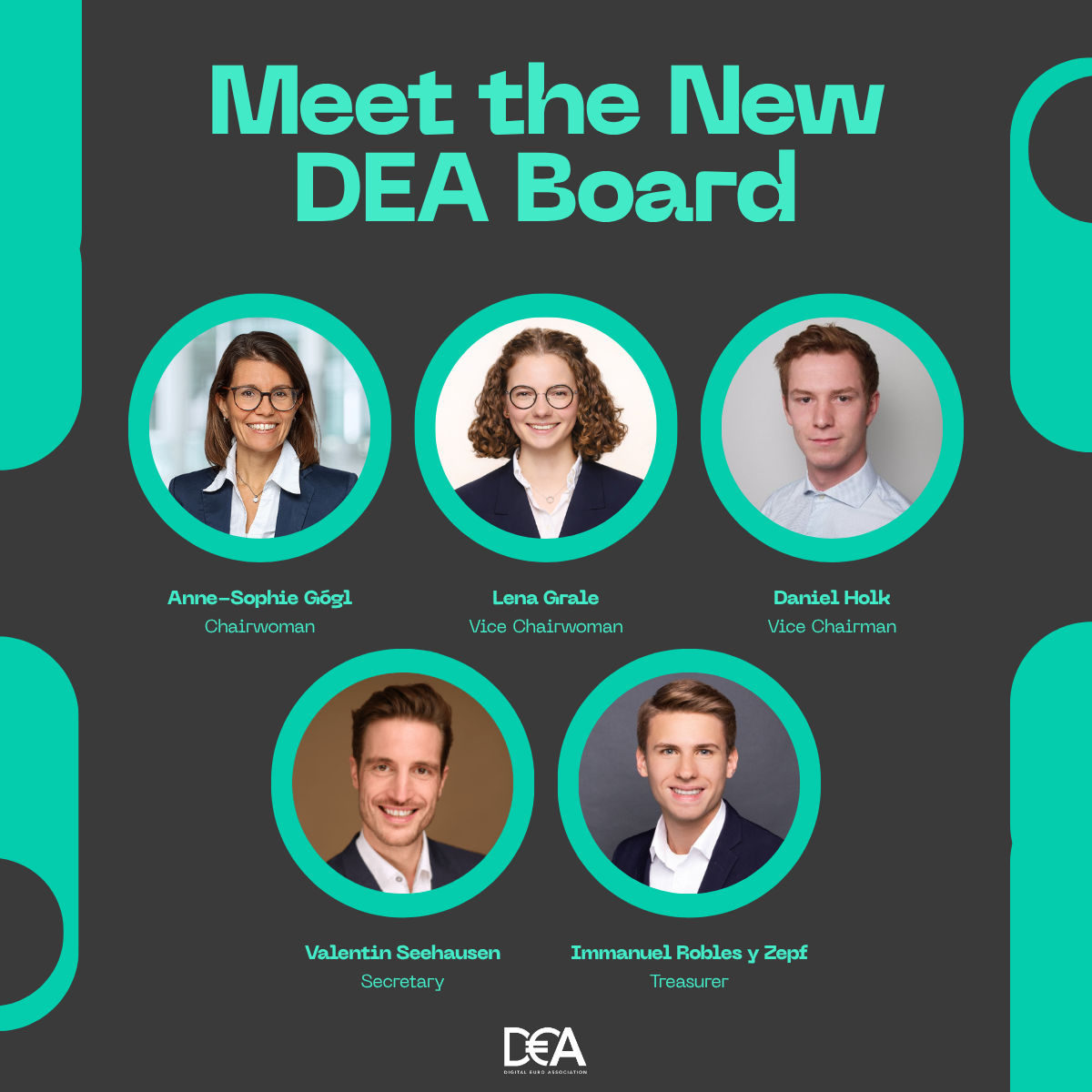
On 8 June 2026, the DEA held its annual General Assembly, bringing together members to reflect on the achievements of 2025, define priorities for the coming year, and reinforce the Association's strategic direction.
During the meeting, members approved the 2025 Annual Report, the 2026 strategy, and the annual budget, reaffirming their commitment to supporting informed dialogue on digital money and the digital euro. Discussions focused on expanding the DEA's public affairs activities, strengthening engagement with European institutions, and increasing opportunities for in-person collaboration across the community.
The General Assembly also marked the beginning of a new chapter for the Association, with a renewed Board and a clear mandate to continue fostering collaboration between policymakers, industry, academia, and technology providers as Europe advances its digital money agenda.
Read more 👇
DEA Member Spotlight Series | Episode 6 - Trust and Survivability by Design – From Offline Payments To Agentic AI Payments
At the DEA Member Spotlight Series, Joachim Samuelsson, CEO of Crunchfish AB, challenged conventional thinking around offline payments by placing them within a much broader discussion on digital resilience.
Drawing parallels with the evolution of the internet, the session explored why modern payment systems remain dependent on centralized, always-on infrastructures and how this creates vulnerabilities that become evident during outages or connectivity disruptions. Rather than treating offline payments as a standalone feature, Joachim presented them as part of a new architectural approach inspired by the internet's ability to continue operating despite failures.
The discussion introduced the concept of governed architectures, where transactions can be executed at the edge while governance, compliance, and trust remain centrally managed. Extending beyond payments, the session examined how these principles could support the future of CBDCs, agentic AI payments, and other forms of critical digital infrastructure.
The presentation offered a forward-looking perspective on how resilience-driven design may shape the next generation of trusted digital systems.
Watch the episode 👇
Events DEA attended
In April, DEA had the opportunity to participate in the following events:
- Austrian Payment Academy: On 14 April 2026, the DEA joined the Austrian Payments Academy with a dedicated course on the retail and wholesale digital euro. The session brought together professionals from across the payments ecosystem – including banks, payment service providers, card networks, merchants and technology providers – to explore the latest policy, technical developments, and implementation considerations surrounding Europe's emerging digital money landscape.
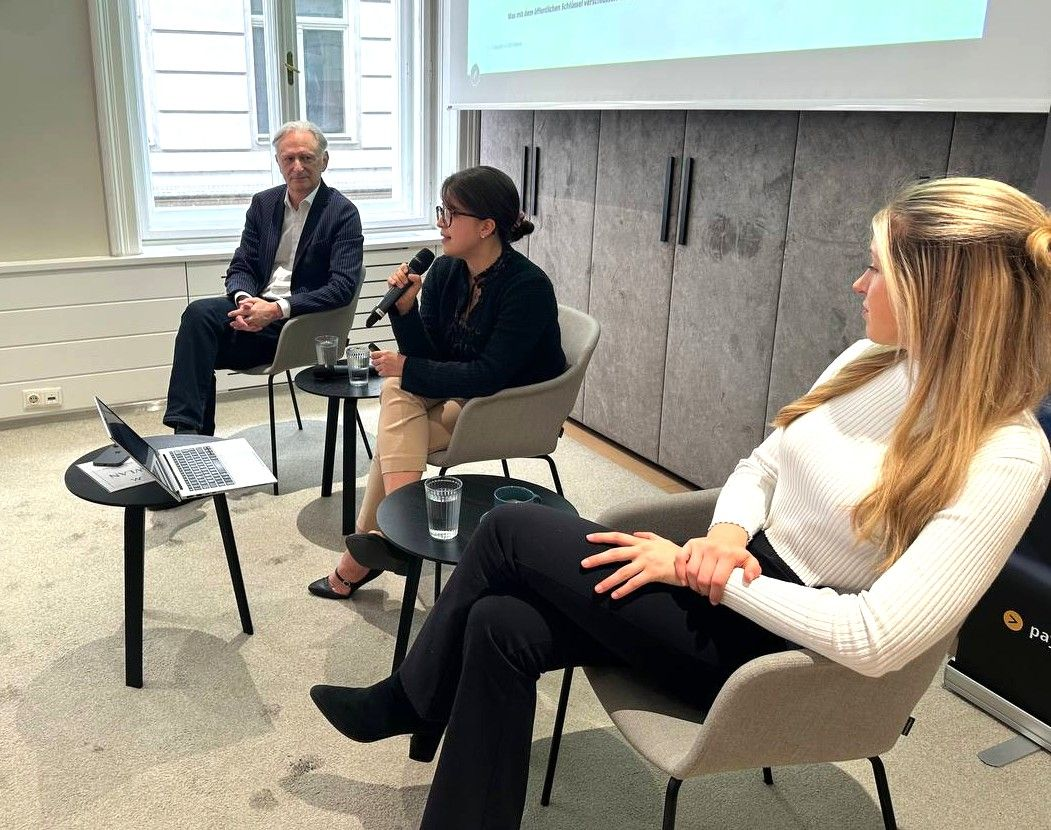
from left to right: Peter Neubauer (APAc), Anna Spengel Portillo (Deloitte), Anne-Sophie Kappel (DEA)
May:
- Digital Money Summit: In May 2026, The DEA attended OMFIF's Digital Money Summit in London, an international forum on central bank digital currencies, stablecoins, tokenisation, and the future of digital money. The event provided valuable opportunities to engage with central banks, regulators, industry leaders and academics, while contributing to the DEA's ongoing monitoring of global developments shaping digital money policy.

June:
- Money in Transition: Digitalisation and Innovation in Payments. On 15 June 2026, the DEA attended the ECB conference, where policymakers, central bankers, regulators, academics, and industry leaders gathered to discuss the future of digital money and financial market infrastructures in Europe. More details here.

- Point Zero Forum 2026
Panel Discussion: What the Future Holds for Europe's Digital Currencies and Payments Landscape
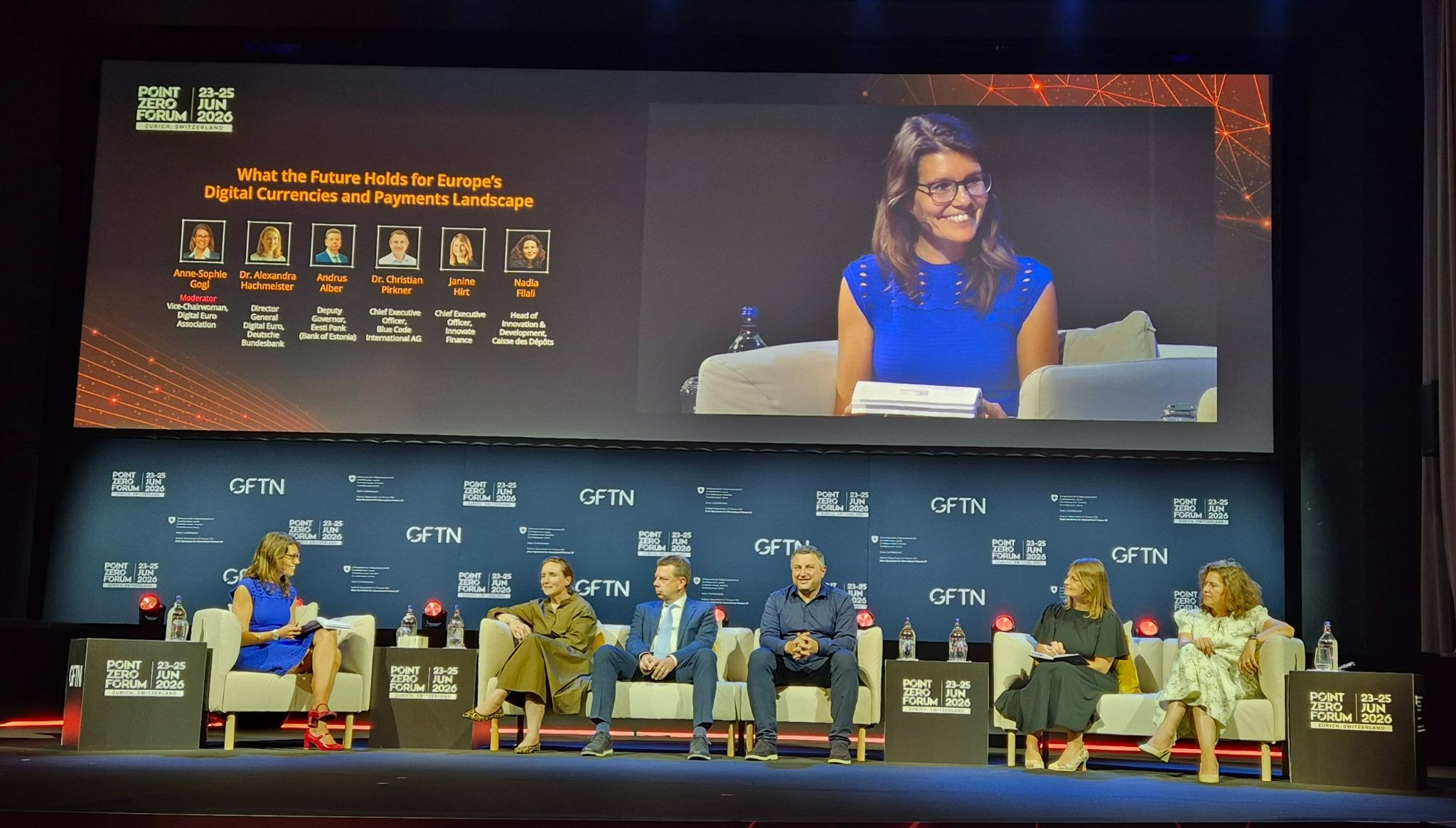
from left to right: Anne-Sophie Gógl (DEA), Dr. Alexandra Hachmeister (Deutsche Bundesbank), Andrus Alber (Eesti Pank), Dr. Christian Pirkner (Blue Code International AG), Janine Hirt (Innovate Finance) and Nadia Filali (Caisse des Dépôts)
- Frankfurt School of Finance & Management
Frankfurt School Executive & Professional Education Programme: Digital Assets & Blockchain Expert
On 24 June 2026, the DEA joined the Frankfurt School’s executive education programme, delivering a full-day course on stablecoins, retail and wholesale CBDC, and the digital euro. The programme equipped professionals from across the financial sector with a comprehensive understanding of the evolving regulatory landscape, technological developments, and strategic implications of digital money.
The DEA remains committed to pioneering the future of digital money, driven by innovation, collaboration, and a shared vision of a digitally empowered world. As we look ahead to the next quarter, we are excited to embark on new endeavors, expand our horizons, and continue making a positive impact. Thank you for being a part of our journey!
⏪ Previous Edition: https://blog.digital-euro-association.de/dea-quarterly-insights-q1-2026
⏩ Next Edition:
No Comments Yet
Let us know what you think