
Cross-border payments
Transfers can move across networks outside banking hours. Total cost and speed still depend on exchange rates, access to funds, compliance and local payment connections.


PRIVATELY ISSUED DIGITAL MONEY
Digital money. A reference value.
Understand how stablecoins work, where euro-denominated stablecoins fit and what MiCA means. Explore the opportunities, the risks and the DEA’s work on Europe’s digital money ecosystem.
Independent insight from the Digital Euro Association
THE EUROPEAN STARTING POINT
In the EU, “stablecoin” is a common label, rather than a standalone MiCA legal category. MiCA defines two relevant types of crypto-asset that aim to maintain a stable value: e-money tokens (EMTs) and asset-referenced tokens (ARTs).
The distinction depends on what the token references. A crypto-asset designed to track the euro alone falls within the EMT definition. Referencing the euro does not make it central bank money or the Eurosystem’s proposed digital euro.
Crypto-assets that aim to maintain a stable value by referencing one official currency, such as the euro. Example: a token designed to track €1. MiCA Article 3(1)(7)
Crypto-assets other than EMTs that aim to maintain a stable value by referencing another value or right, or a combination, including one or more official currencies. Example: a token referencing a basket of currencies. MiCA Article 3(1)(6)
A shared currency reference. A different issuer and legal claim.
THE EUROPEAN PERSPECTIVE
MiCA, also called MiCAR, sets requirements for stablecoin issuers and related services in the EU. Classification is the starting point. Issuer authorisation, holder rights and disclosures determine how the rules apply in practice.
The rules for these categories have applied since 30 June 2024. For e-money tokens offered in the EU, the general rule is that the issuer must be authorised as a credit institution or electronic money institution and publish a notified white paper, subject to statutory exemptions.
October 2026 update: ESMA has set out supervisory expectations for services involving unauthorised stablecoins. Availability on a platform does not establish compliance. Check the issuer, token and provider separately.
The general rule is an authorised credit institution or electronic money institution, subject to MiCA’s requirements and statutory exemptions.
EMT holders have a claim on the issuer and a right to request redemption at any time and at par value. The white paper must explain the conditions.
A service provider’s authorisation is different from an issuer’s status. Verify the legal entity, token and permitted activities separately.
FROM DESIGN TO PRACTICE
The opportunity depends on the whole payment journey: acquiring the token, transferring it and converting or redeeming it. On-chain speed alone does not tell the full story.
Transfers can move across networks outside banking hours. Total cost and speed still depend on exchange rates, access to funds, compliance and local payment connections.
Smart contracts can link a payment to agreed conditions. Reliable data, secure code and clear responsibilities remain essential.
Stablecoins are used to trade and move value in crypto-asset markets. They can also serve as a payment asset in tokenised market arrangements, subject to the relevant rules.
Connected devices could pay for energy, mobility or digital services. The DEA explores these applications in its research on machine money.
Stability is an objective, not a certainty.
Assets can lose value or become difficult to sell. Heavy redemption demand can put pressure on the peg.
Legal rights, insolvency arrangements and access to redemption affect whether holders can recover funds.
Network outages, contract vulnerabilities, custody failures and lost keys can disrupt access or cause losses.
MiCA adds obligations and protections. EMTs are not covered by EU deposit guarantee or investor compensation schemes. Read the required disclosures
EXPLORE THE DEA’S STABLECOIN WORK
Explore DEA stablecoin research, follow EU regulatory developments and contribute to the discussion on Europe’s stablecoin ecosystem.
DEA STABLECOIN COMMITTEE
Explore the DEA’s independent pan-European forum, bringing together institutional perspectives on regulation, market developments and the future of euro stablecoins.
DEA market data · ESMA registers Search EMT issuers, authorised service providers and entities flagged as non-compliant. Check the ESMA source data date and methodology. Explore the tracker →

DEA working group paper · 2025 How stablecoins affect monetary, payments, regulatory and digital sovereignty, with strategic considerations for EU policymakers. Read the paper →
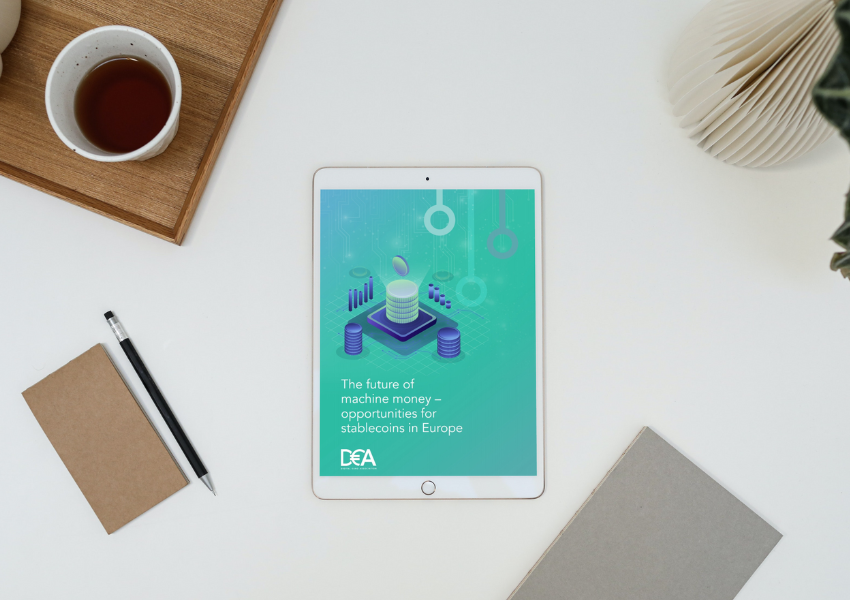
DEA & Lipis Advisors · 2023 Explore potential stablecoin applications in Europe’s machine-to-machine economy, including industry use cases and design considerations. Read the paper →
A European reading list, led by the DEA’s own work. Publication dates distinguish earlier research from current rules and recent policy proposals.
DEA POLICY RESPONSE · OCTOBER 2026
DEA’s proposals on redemption, reserve requirements, multi-issuance and proportionate regulation. These are policy proposals, distinct from the law currently in force.
DEA WORKING GROUP PAPER · 2025
Strategic considerations for EU policymakers across monetary, payments, regulatory and digital sovereignty.
DEA WORKING GROUP PAPER · 2024
Industry perspectives on opportunities and regulatory challenges as MiCA’s stablecoin provisions began applying. Read alongside current EU law and supervisory guidance.
DEA & LIPIS ADVISORS · 2023
A study of potential IoT and machine-to-machine payment applications. Its regulatory discussion reflects the publication date.
EU LAW · REGULATION (EU) 2023/1114
The legal source for EMT and ART definitions, issuer obligations, reserves, redemption and related services. Use EUR-Lex’s current consolidated text when checking amendments.
FINANCIAL STABILITY BOARD · OCTOBER 2026
Analysis of cross-border reserve, redemption and supervisory vulnerabilities, and the information needed to monitor them.
BIS WORKING PAPER NO 1385 · OCTOBER 2026
Research comparing total payment costs across different routes. A working paper by its authors, rather than an official BIS policy position.
YOUR QUESTIONS, ANSWERED
Clear answers on euro stablecoins, private digital money and the EU rules.
It is a broad description of privately issued digital money denominated in euro. On this page, the focus is euro stablecoins. Tokenised commercial bank deposits are another form of private digital money, with a different legal basis. Always identify the instrument and the holder’s claim.
No. Their market price can move away from the intended reference value. Backing, liquidity, confidence in the issuer, redemption arrangements and operational problems can all affect the peg.
No. A euro stablecoin is privately issued. A digital euro issued by the Eurosystem would be central bank money. Referencing the same currency does not make their issuers, legal claims or protections equivalent.
An EMT references one official currency. An ART is not an EMT and references another value or right, or a combination, including one or more official currencies. The design and legal classification determine which requirements apply.
Yes. Under MiCA, authorised credit institutions and electronic money institutions can issue EMTs, subject to the applicable requirements. Issuance is distinct from custody, exchange, distribution and other services that banks or other providers may offer.
MiCA gives EMT holders a claim against the issuer and a right to request redemption at any time and at par value, paid in funds other than electronic money. The white paper must explain the conditions. A sale on an exchange is a different transaction and may involve a different price or intermediary fees.
No. MiCA requires EMT white papers to warn that EMTs are not covered by EU deposit guarantee schemes or investor compensation schemes. Authorisation does not eliminate market, issuer or operational risk.
Use the DEA MiCAR Tracker to explore ESMA register data on EMT issuers, authorised service providers and entities flagged as non-compliant. Check the displayed data date and methodology. Verify a legal entity’s current status and permissions against ESMA’s register and the relevant national authority. A service provider’s authorisation does not establish that every token it lists complies with MiCA.
KEEP EXPLORING
Understand CBDCs, the digital euro and how public digital money differs from euro stablecoins.
CONNECT WITH THE DEA
Connect with the DEA’s community across banking, payments, technology, academia and policy. Explore institutional membership and our work on the future of digital money.