

Share this
by Digital Euro Association on Dec 15, 2025, 3:48:13 PM
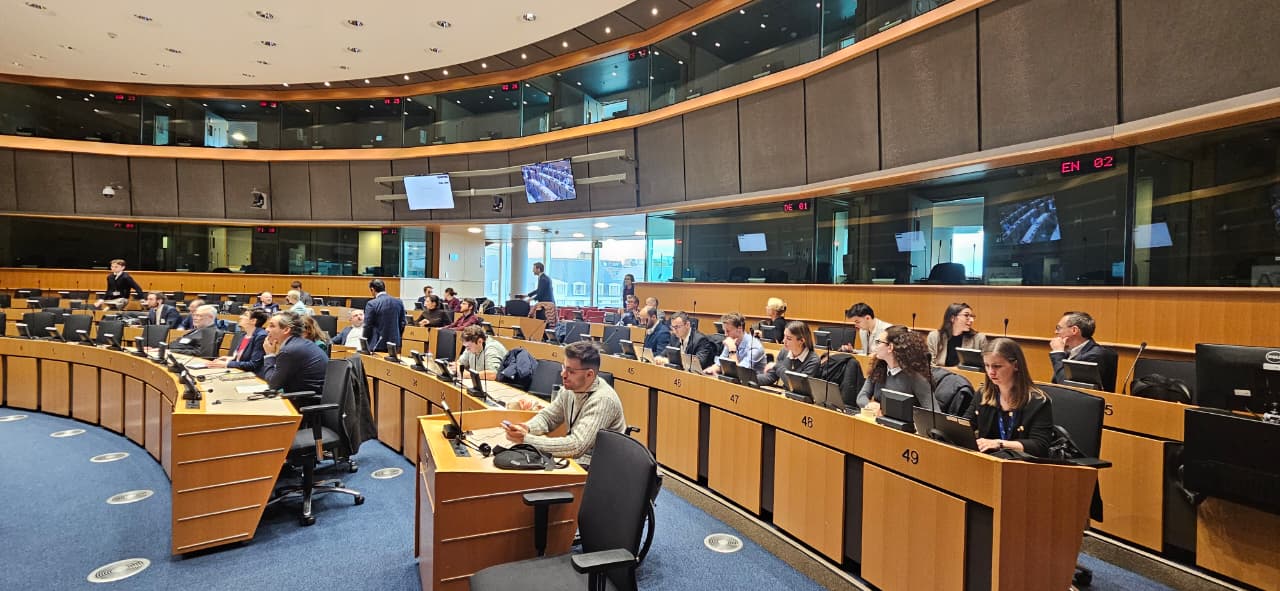
On 2 December 2025, we convened our Digital Euro Dialogue at the European Parliament in Brussels, bringing together policymakers, supervisors, banks, payments players, merchants, and academics for a practical conversation on where Europe’s digital money agenda is actually heading.
With the ECB moving into the next phase of the digital euro project and the European Parliament advancing key files in the Single Currency Package, the discussion was less about “whether” and more about “what do the use cases look like, for whom, and how does that fit in with existing payment methods?”.
Three takeaways
-
Sovereignty is becoming a design input, not just a talking point.
Participants kept coming back to Europe’s dependencies across the payments stack, from devices and operating systems to wallets, rails, identity, and acceptance. The real question was where Europe needs optionality and resilience, and where global interdependence is simply a fact of life. -
Retail and wholesale are diverging, fast.
Retail CBDC debates are increasingly shaped by public policy outcomes: inclusion, resilience, and trust in payments. Wholesale discussions are being pulled by market structure questions: settlement efficiency, interoperability, and what “tokenisation at scale” actually requires from money and infrastructure. -
The next phase will be won on implementation, not slogans.
Across the room, there was appetite for experimentation with real constraints: privacy and AML, offline functionality, holding limits, merchant acceptance and incentive, user experience, and governance. The conversation is shifting from principles to trade-offs.
Retail: what should a digital euro actually do?
 Panel 1: The Retail Digital Euro: From Legal Basis to Implementation
Martijn van der Linden (The Hague University), Dr. Jonas Gross (DEA), Alessia Benevelli (EBA), Anna Lachambre (ECommerce Europe), Christophe Bonte (EBF)
A central tension ran through the retail discussion: the digital euro can’t be everything to everyone, and trying to make it so risks weakening the proposition.
The most grounded framing was outcome-led. If the digital euro is meant to strengthen Europe’s payments resilience and autonomy, then design choices must follow from that. That includes hard questions about offline capability, ease of use in everyday retail payments, the role of intermediaries, and how privacy expectations can be met without undermining safeguards.
Holding limits and remuneration also remain politically sensitive and technically consequential. The discussion reflected a desire for flexibility, paired with clear guardrails so that the digital euro complements, rather than destabilizes, the existing deposit and payments ecosystem.
 Panel 2: The Wholesale Digital Euro: Infrastructure, Capital Markets & Geopolitics
Dr. Joachim Schwerin (European Commission), Anne-Sophie Gogl (DEA), Jonathan Leßmann (SWIAT), Stephan Möegelin (BaFin, Chair of ESMA Working Group on DLT)
Wholesale: on-chain finance needs on-chain money
On the wholesale side, the mood was more “how do we build” than “should we build”. With financial market infrastructure evolving and tokenised assets moving from pilots toward production, the role of wholesale central bank money in settlement is increasingly central.
Participants explored the need for interoperability across platforms and jurisdictions, and for clear governance around how different layers of the stack fit together: commercial bank money, tokenised deposits, stablecoins, and wholesale CBDC. The practical insight was simple: tokenisation at scale needs settlement assets that are trusted, widely usable, and operationally compatible with how markets actually work.
What happens next
If there was a shared conclusion, it was that Europe’s digital money debate is entering a phase where implementation will carry the real policy weight. That is exactly why these mixed rooms matter: the trade-offs get sharper when you have legislators, supervisors, infrastructure providers, banks, merchants, and technologists testing assumptions against each other.
We will continue these conversations in 2026, with the goal of deepening relationships in Brussels and keeping the dialogue practical, not performative.
If you’d like early access to invitations, member briefings, and small-format roundtables, membership is the simplest way to stay close to the work.
No Comments Yet
Let us know what you think