
Tokenised deposit
Bank money, on programmable infrastructure.
- Issuer
- A credit institution
- Claim
- A deposit claim against the bank
- EU treatment
- Banking rules; eligible deposits may have DGS protection


TOKENISED COMMERCIAL BANK MONEY
Bank money. New possibilities.
Understand tokenised bank deposits, how they differ from stablecoins and CBDCs, and their role in Europe’s digital money ecosystem. Explore the uses, the safeguards and the DEA’s research.
Independent insight from the Digital Euro Association
START WITH THE CLAIM
Tokenised deposits are commercial bank deposits recorded on a distributed ledger or similar programmable infrastructure. The depositor holds a claim against the bank.
In the EBA’s narrow definition, changing the ledger does not by itself change a deposit’s legal nature. Often called “tokenized deposits”, they can connect bank money with programmable payments and tokenised assets.
The label alone is not enough. The holder’s rights, the issuing entity and the design determine what an instrument actually is.
The bank owes the depositor the balance. Tokenisation alone does not change that legal relationship. Start with the rights, rather than the token’s name.
A programmable ledger can connect deposits with payment conditions and tokenised assets. Customer access, transfer rules and settlement still need to be designed.
THREE FORMS OF DIGITAL MONEY
Tokenisation does not make every form of money equivalent. Start with who owes you the money and the rights attached to it.
Bank money, on programmable infrastructure.
A token aiming to maintain a euro reference value.
Digital money issued by a central bank.
This stablecoin comparison focuses on euro-denominated e-money tokens (EMTs). A bank can issue either a deposit or an EMT; its identity alone does not settle the classification.
FOLLOW THE PAYMENT
One illustrative model for a payment between customers of different banks. Other designs and settlement arrangements are possible.
An eligible customer initiates a payment from a tokenised deposit at Bank A.
For a transfer between banks, the arrangement must settle the banks’ obligations, for example in central bank money.
Bank B credits its customer with a deposit claim against Bank B. The customer does not have to hold Bank A’s liability.
Settlement in central bank money can connect the banks’ separate liabilities and support their exchange at par. A token transfer alone does not establish legal settlement finality.
THE EUROPEAN PERSPECTIVE
Tokenised deposits sit within Europe’s banking system when the underlying instrument qualifies as a deposit. MiCA excludes deposits from its scope.
The Eurosystem’s payments strategy envisages central bank money anchoring settlement, alongside properly designed and regulated private money, including tokenised deposits and stablecoins.
For any product, check the issuing bank, the legal claim, eligibility, transfer restrictions and settlement arrangements. “Tokenised” describes a technology choice, not a guarantee of protection.
The product’s substance and the depositor’s rights matter. Bank-issued EMTs remain a separate category.
EU DGS protection generally covers eligible deposits up to €100,000 per depositor, per bank. Eligibility, exclusions and national rules must be checked.
Access may require an identified customer relationship. Moving between banks needs an agreed transfer and settlement mechanism.
FROM DESIGN TO PRACTICE
The opportunity is to connect bank money with assets, data and business logic. Benefits depend on the full arrangement, including the systems around the ledger.
A payment can execute when agreed conditions are met, connecting money with business processes. Secure code and reliable external data are essential.
Firms could automate liquidity movements and reconcile payment records more closely with their internal systems. Access and operating hours depend on the service.
A deposit can provide the cash side of an asset transaction. Delivery-versus-payment requires coordinated transfers and legally effective settlement.
Shared platforms can connect bank deposits and central bank reserves across currencies. Project Agorá explores this approach; its prototype is distinct from a generally available service.
A new ledger does not remove banking or operational risks.
Clear deposit rights, enforceable transfers and settlement finality across relevant jurisdictions.
Connections between banks, ledgers and payment systems, with sufficient settlement liquidity.
Secure contracts, identity checks, data protection and recovery arrangements when systems fail.
A pilot demonstrates a design under particular conditions. Assess production availability, customer access and legal protections separately.
EXPLORE THE DEA’S WORK ON TOKENISED DEPOSITS
Start with the DEA working group’s primer and hear directly from its chairs. Read the earlier research alongside current European supervisory and policy sources.
DEA WORKING GROUPS
Explore collaborative research across commercial bank money, stablecoins and central bank digital currencies.
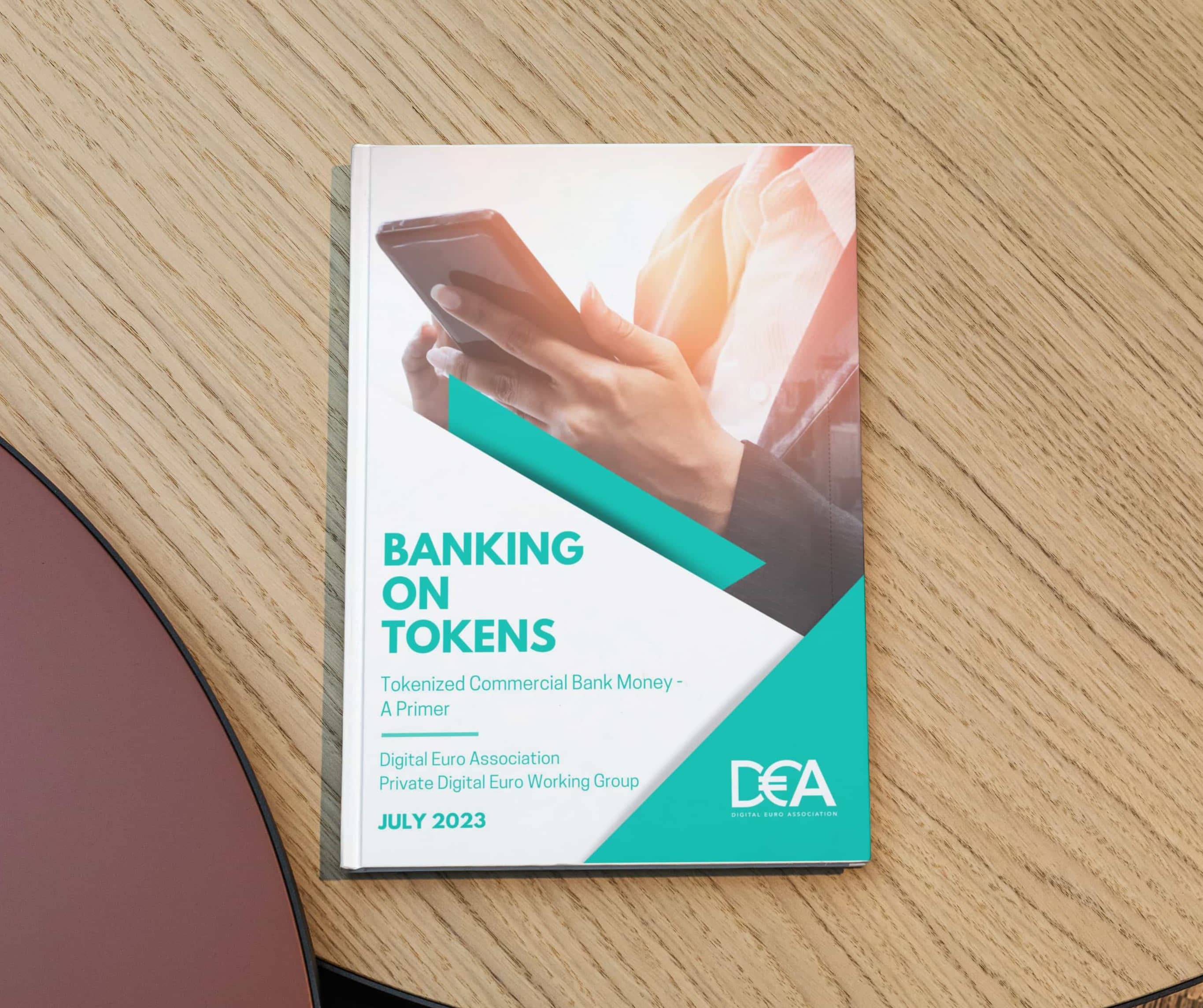
DEA working group paper · 2023 A primer on tokenized commercial bank deposits: uses, risks and implications for banking and the wider monetary system. Read the paper →

Digital Euro Podcast · Episode 50 · 2023 The working group chairs discuss the primer’s use cases, regulatory questions and recommendations. Listen to the discussion →
Publication dates distinguish foundational research from later policy developments. The DEA primer expresses the views of its working group participants.
DEA WORKING GROUP PAPER · 2023
The foundational primer on tokenized commercial bank deposits. The paper reflects its publication date and the views of its working group participants.
EUROPEAN BANKING AUTHORITY · 2024
The EBA’s analysis of deposit classification, indicative design characteristics, potential benefits and supervisory challenges.
EUROSYSTEM · 2026
The European policy context for tokenised settlement assets, central bank money and integration across payments.
BIS INNOVATION HUB · 2026
A report on the prototype for wholesale cross-border payments combining tokenised deposits and central bank reserves. Follow the project page for subsequent developments.
BIS SPEECH · 2025
A monetary-system perspective on bank deposits, programmability and the conditions for preserving trust.
EU LAW
The exclusion of deposits from MiCA. Classification must follow the instrument’s legal substance.
EUROPEAN BANKING AUTHORITY
The EU deposit protection context. Coverage depends on the depositor, the deposit, applicable exclusions and the relevant scheme.
YOUR QUESTIONS, ANSWERED
Clear answers on bank money, legal rights and how tokenisation changes payments.
Yes. Most bank deposits are already recorded electronically. Tokenisation changes the infrastructure used to record and process the claim, potentially connecting it with programmable transactions and tokenised assets.
No. A bank can issue different kinds of instruments. A deposit is a deposit claim against the bank; a bank-issued e-money token has a different legal basis and is subject to MiCA’s EMT provisions. The issuer’s banking licence alone does not make every token it issues a deposit.
MiCA excludes crypto-assets that qualify as deposits. That does not mean they are unregulated: banking law and other applicable requirements continue to apply. Whether a particular product qualifies is a legal classification question. Read MiCA Article 2
Eligible deposits may be covered by the relevant deposit guarantee scheme. EU protection generally extends up to €100,000 per depositor, per bank, subject to eligibility, exclusions and applicable rules. Tokenisation creates no extra coverage, and balances held with the same bank generally count together. Check the EBA’s deposit protection information
Not necessarily. Transferability depends on the product and network rules. Some designs bind the deposit claim to an identified bank customer. A payment to a customer at another bank needs a supported interbank arrangement; it is not simply a transfer of the same bank claim to anyone.
Interest depends on the deposit contract and the applicable rules. Using a programmable ledger does not itself decide whether interest is paid.
No. The depositor’s claim remains against a commercial bank. Central bank money can provide settlement between banks, connecting their separate deposit liabilities. It is a different instrument with a different issuer.
Follow official bank disclosures and project updates, including Project Agorá. Check who can participate, what has been tested and whether the service is a pilot, a prototype or a production offering. A demonstration does not establish general availability.
KEEP EXPLORING
Explore stablecoins and CBDCs, their legal claims and their place alongside commercial bank money.
CONNECT WITH THE DEA
Connect with a community spanning banking, payments, technology, academia and policy. Explore institutional membership and the DEA’s research and events.